We (at least here) call the normalized dose the “dose basis”. So maybe dose_basis_unit_concept_id? Or maybe that’s thinking too focusedly . . .
What about ‘rate’? so exposure_rate and exposure_rate_unit? Seems like we’re talking about 2 things possibly happening when a patient is exposed to a drug: they get a dose of something or they are exposed at a rate of something. I found this discussion here, tho it was describing radiation, but the idea might apply to our drug exposure table:
https://www.nucleonica.com/forum/showthread.php?301-Diffrence-between-Dose-and-Exposure-Rate
So, this way, you can have someone exposed to the same mass of a drug as another person, but the rate could be different between them. Maybe we can standardize the units to either by time (to a day) or by weight (to a gram),
looks like the discussion goes to the relative units only
@Christian_Reich, another example where we have problems is when the substance can be present both in iU and mg.
and conversion is not so easy in this case.
and it’s not so easy to convert.
@Alexdavv, I know you tried something, can you share?
Not a bad idea.
Yes, but we already were talking about two things before: Absolute unit based (=dry) dose like in tablets, and divisible dose (=liquid). Now we are talking a third thing: the first derivation thereof. We haven’t made those distinctions canonical, except when we want to calculate daily doses (e.g. for DOSE_ERA records). That’s when we need the complex @Klaus-like logic. This will add to that.
We could try figuring it out. But won’t be easy on the ETLers, because instead of just dumping NDC codes they will have to start getting into the detail.
Correct, but I would definitely not open the door for that. In contrast, in the long run we should provide means to convert. The conversation here is about what dose is actually given. Not how it can be differently represented.
That is the idea, @alexdaw. We will fix it.
+1 for @bailey’s idea
And this would be the concept_id for the dose_unit_source_value field, correct?
I’ve added a proposal to create a dose_unit_concept_id field for the dose_unit_source_value field here
@Bailey I’ve changed the field name that you proposed to stay in line with naming conventions. Keep the concept_id name the same as the source_value name
@Christian_Reich @clairblacketer Would this be considered a bug fix since the source value didn’t have a corresponding concept id field?
Hi everyone! @Christian_Reich @MPhilofsky
Some time passed, and now it seems like there are some use cases for oncology research (at least it was a hot topic on the European OHDSI Symposium). So this question might be relevant again:
→ how to calculate/enter into CDM the dose for drugs which have a /bsa (body surface area) or /kg as a unit denominator, and a database does not have the patient’s weight or body surface. (If it were available, it would be easy to calculate the dose.)
I looked up the GitHub discussion and the “How to calculate drug dose”, but I did not see any answer, and there is a mention in CDM 5.4 that dose_unit_source_value will be deprecated.
Is there any update or convention on how these drug doses should be calculated or entered into the CDM?
Thank you in advance!
PS: our use case - we are facing this problem when mapping our oncology drug exposure data in Hungary, which contains drug exposure with these limitations.
Hello @Agota_Meszaros
this documentation gives guidance on how to calculate drug dose.
If you do not have a person’s weight, then I’m unsure how you would calculate the dose for a drug which is dependent on body weight since many drugs are titrated to effect. This means the actual dose is variable and dependent on a person’s response to a drug.
What data do you have and what question are you trying to answer? Please give de-identified examples. We do not need any PHI or PII variables to help us answer.
Thank you for the documentation! I read through it. I see now, you are right, we can not enter the doses into our CDM without knowing the patient’s body weight or body surface - sadly, it is only present as free text in our database.
The data recording of chemotherapy in Hungary is the following: on the first day of the chemotherapy protocol, the patient gets a procedure code for that chemotherapy protocol (Hungary-specific code), eg, 70201
These codes are listed in a Chemotherapy codebook, alongside the timing (day) and doses of the chemotherapeutic agents which are given to the patient, eg.
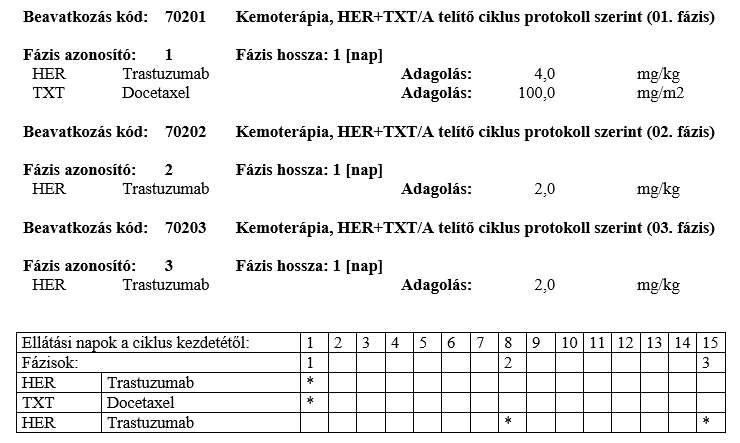
I know it is in Hungarian, I only wanted to show the structure - this is part of the Chemotherapy codebook.
So, as a conclusion - thank you for your help @MPhilofsky - we will only include the ingredients as drug exposure in our CDM.
1 Like
You’re welcome, @Agota_Meszaros!
I suggest you also reach out the Oncology WGs. They might have some suggestions on if you should and how you should pull additional data elements or attributes needed for cancer research.
1 Like